
Puneet Rana
-
Position:Associate Professor of Mathematical Sciences
-
College:College of Science, Mathematics and Technology
-
Office:CSMT 559
-
E-mail:
EDUCATIONAL BACKGROUND
| 2009 – 2013 | PhD in Mathematics |
| Indian Institute of Technology Roorkee, India | |
| 2006 – 2008 | M.Sc. (Honours School) in Mathematics |
| Panjab University, Chandigarh, India | |
| 2003 – 2006 | B.Sc. in Mathematics, Physics and Chemistry |
| Panjab University, Chandigarh, India |
ACADEMIC EXPERIENCE
2024 -- present Director, WKU Centre for Applied Mathematical Modelling and Computation.
2025 -- present Coordinator, M.S. in Mathematics, Statistics and Data Analytics.
2020 -- 2026 Assistant Professor of Mathematics, Wenzhou-Kean University, China.
2013 -- 2020 Assistant Professor, Jaypee Institute of Information Technology, India.
BIOGRAPHY
Dr. Puneet Rana is an Associate Professor of Mathematics at Wenzhou-Kean University (WKU), Wenzhou, China, with over sixteen years of teaching and research experience. He earned his Ph.D. in Mathematics from the Indian Institute of Technology Roorkee, India, where his doctoral research focused on finite element modelling of transport phenomena in nanofluids. He has supervised five Ph.D. students to completion, with one currently ongoing, and has mentored more than twenty undergraduate capstone projects at WKU. Dr. Rana has published over 100 Scopus-indexed articles, including 105 publications indexed in the Web of Science Core Collection, with more than 70% published in Q1 journals and a cumulative journal impact factor exceeding 314. His research has received more than 4,300 Google Scholar citations (h-index 36, i10-index 76) and over 3,300 Scopus citations (h-index 31). He has been recognized among Stanford University's Global Top 2% Most-Cited Scientists for five consecutive years (2021–2025) and is a two-time recipient of the WKU Award of Excellence in Research and Creativity (2021, 2023). He has led externally recognized research programs at WKU totaling approximately RMB 400,000, delivered keynote and invited talks in China, India, Japan, South Korea, Australia, and Canada, and serves as a guest editor and reviewer for leading journals, including Physics of Fluids, Scientific Reports, International Journal of Heat and Mass Transfer, and Applied Mathematical Modelling.
RESEARCH INTEREST
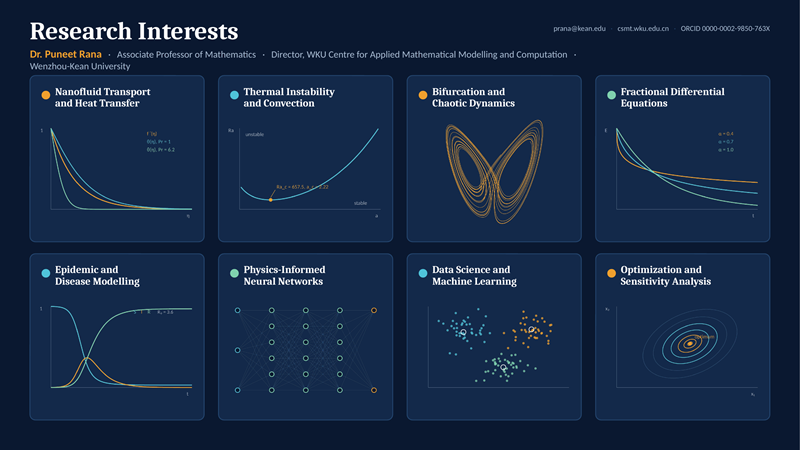
Nanotechnology and nanofluids; computational fluid dynamics; heat and mass transfer; linear and nonlinear thermal instability; boundary-layer and non-Newtonian flows; bifurcation and chaotic dynamics; fractional differential equations; epidemic and disease modelling; data science and machine learning for engineering systems.
COURSES TAUGHT
-
MATH 1016 Statistics
-
MATH 2415 Calculus I
-
MATH 2416 Calculus II
-
MATH 2526 Applied Statistics I
-
MATH 2995 Matrix and Linear Algebra
-
MATH 3415 Calculus III
-
MATH 3455 Differential Equations
-
MATH 3710 Foundations of Data Analysis
-
MATH 3940 Numerical Analysis
-
MATH 4451 Real Analysis I
-
MATH 4809 Special Topics in Mathematics
-
MATH 4890 Senior Seminar
PH.D. STUDENTS SUPERVISED
-
Ruchika Dhanai (2013 -- 2017). Numerical study of MHD flow and heat transfer problems in nanofluids.
-
Nisha Shukla (2015 -- 2019). Application of homotopy analysis methods to transport phenomena in nanofluids.
-
Meenakshi Khurana (2013 -- 2020). Convective instability and heat transfer in Newtonian and non-Newtonian nanofluids.
-
Vishal Gupta (2017 -- 2024). Thermal stability analysis and neural network prediction in Rayleigh–Bénard nanofluid problems.
-
Akash Kumar (2019 -- 2024). Numerical investigation and optimization of thermal transport in nanofluid flow models.
-
Anju Gahlyan (2025 -- present). Machine learning techniques in computational fluid dynamics (ongoing).
SELECTED PUBLICATIONS
- Rana, P., Malhotra, S., Kumar, S., Areekara, S. (2026). Bi-viscous Bingham nanofluid radiative flow in a stationary cone–disk system with Hall current. Case Studies in Thermal Engineering, 82, 108072.
- Gahlyan, A., Mahajan, A., Rana, P. (2026). Homotopy-based neural network framework for multiplicity and stability of solutions for tetra hybrid nanofluid in channel flow. Chinese Journal of Physics, 103, 1605–1633.
- Rana, P., Zhu, X., Agarwal, S. (2025). Chaotic convection in an Oldroyd-B nanofluid for the Horton–Rogers–Lapwood problem with gravity modulation. Physics of Fluids, 37(1).
- Rana, P., Zhu, X., Pop, I. (2025). Multiplicity and stability of solutions in non-Newtonian Carreau nanofluid with nonlinear Rosseland approximations. Case Studies in Thermal Engineering, 105821.
- Rana, P., Basavarajappa, M. (2024). Penetrative convection in Navier–Stokes–Voigt fluid induced by internal heat source. Chaos, Solitons & Fractals, 189, 115689.
- Rana, P., Basavarajappa, M. (2024). Bioconvective flow in the conical region of rotating and stationary cone–disk geometries. Physics of Fluids, 36, 112038.
- Rana, P. (2023). Heat transfer optimization and rheological features of Buongiorno nanofluid in a convectively heated inclined annulus. Propulsion and Power Research, 12, 539–555.
- Rana, P., Ma, J., Zhang, Y., Gupta, G. (2023). FEM simulation and optimization for a hybrid magneto-nanofluid in an inclined free convective energy system. Alexandria Engineering Journal, 70, 45–59.
- Rana, P., Kumar, A. (2022). Nonlinear buoyancy driven flow of hybrid nanoliquid past a spinning cylinder with quadratic thermal radiation. International Communications in Heat and Mass Transfer, 139, 106439.
- Rana, P., Gupta, G. (2022). FEM solution to quadratic convective and radiative flow of Ag–MgO/H₂O hybrid nanofluid over a rotating cone with Hall current. Mathematics and Computers in Simulation, 201, 121–140.
- Rana, P., Shukla, N., Gupta, Y., Pop, I. (2019). Homotopy analysis method for predicting multiple solutions in channel flow with stability analysis. Communications in Nonlinear Science and Numerical Simulation, 66, 183–193.
- Rana, P., Bhargava, R. (2012). Flow and heat transfer of a nanofluid over a nonlinearly stretching sheet. Communications in Nonlinear Science and Numerical Simulation, 17, 212–226.
EDITED BOOK
-
Advances in Intelligent Systems and Computing, Springer. https://doi.org/10.1007/978-981-16-6887-6
-
Lecture Notes on Data Engineering and Communications Technologies, Springer. https://doi.org/10.1007/978-981-99-3432-4
GRANTS
-
Thermal Performance of Solar Collectors Utilizing Hybrid Nanomaterials with Machine Learning. IRSP, IRSPG202104, 100,000 RMB, 2021–2025 (PI).
-
Meta-Heuristics and Machine Learning for Thermal Characteristics of Nanofluids in Renewable Energy and Biomedical Systems. ICRP, ICRP202205, 300,000 RMB, 2022–2025 (PI).
-
Machine Learning Model for Physical Field Reconstruction in Ternary Hybrid Nanofluids. SpF, 30,000 RMB, 2023–2024.
-
Optimal Geometry of Complex Channels and Cavities for Efficient Energy Systems. SpF, 22,000 RMB, 2022–2023.
-
Traffic Sign Detection and Recognition for Self-Driving Cars. SpF, 15,000 RMB, 2022–2023.